


News
New Hot Stamping Technology: TFS-200 Pneumatic Flatbed Hot Stamping Machine Solution


In packaging decoration, trademark nameplate production, and gift craftsmanship, hot stamping has always held a significant position due to its unique metallic luster and luxurious texture. The quality of the final hot-stamped effect largely depends on the performance and precision of the core equipment—the hot stamping machine. Designed specifically for small to medium-batch, high-precision stamping needs, the TEFISEN TFS-200 Pneumatic Flatbed Hot Stamping Machine integrates a robust mechanical structure, precise pneumatic control, and an intelligent temperature management system, embodying the technical sophistication of flatbed hot stamping.
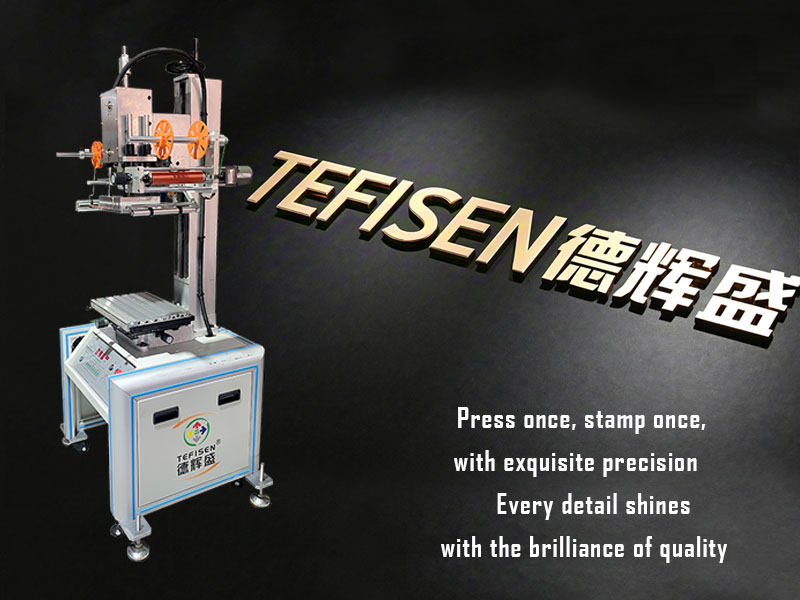
I. Features of the TEFISEN TFS-200 Pneumatic Flatbed Hot Stamping Machine
The TEFISEN TFS-200 is designed for long-term stable operation. Its compact dimensions (L1000 × W750 × H1900 mm) provide ample workspace (with a center height adjustable to 800 mm ± 25 mm) while ensuring overall stability. Weighing approximately 280 kg, the machine features a cast iron base and support structure—a choice that prioritizes vibration resistance and structural integrity during extended operation, offering an unwavering foundation for the entire stamping process.
The core mechanism of hot stamping—the precise contact between the heating plate and the substrate—is executed by a refined lifting system. Driven by an SA80×100-30 pneumatic cylinder, this system delivers smooth and powerful linear motion. With an optimized piston rod diameter and stroke design, it provides up to 350 kg of pressure across a 100–30 mm lift range, accommodating materials from paper to rigid plastics. To ensure absolute vertical accuracy and resistance to eccentric loads, the machine is equipped with Ø20 mm precision lifting guide rails that work in tandem with the cylinder, eliminating any minor plate tilt or vibration during pressing—critical for uniform stamping pressure.
The worktable (380 × 280 mm) also reflects a focus on process details. Beyond its generous size, it offers X- and Y-axis fine adjustment of ±15 mm and angular adjustment of ±5°, enabling operators to precisely align the stamping pattern without removing the workpiece. This is especially valuable for multi-layer stamping or touch-up work requiring high registration accuracy, boosting both flexibility and yield.
II. Core Advantages of the TEFISEN TFS-200 Pneumatic Flatbed Hot Stamping Machine
The TFS-200 employs a “flatbed hot stamping” approach as its technical cornerstone. Compared to roller stamping, the flatbed method uses a fully planar heating plate (stamping area: 220 × 170 mm; effective area: 200 × 150 mm) that makes uniform, simultaneous contact with the entire workpiece surface under pneumatic drive.
This design offers two clear benefits:
1. Consistent Pressure Distribution: Simultaneous contact and pressing ensure even pressure across the foil and substrate surface, avoiding gradients common in roller stamping. This results in sharp, fully transferred metallic details—whether simple or intricate—with no blurred edges.
2. Wide Material Compatibility: Particularly effective on uneven, textured, or slightly elastic surfaces (such as leather, embossed cards, or soft plastics), flatbed stamping allows the foil to conform closely to substrate textures for complete transfer. Roller methods may struggle with such materials due to line-contact pressure variation.
An anti-pinch safety device and an opening adjustment handwheel (0–300 mm range) further enhance safety and ease of use. Operators can quickly set the initial lift height based on workpiece thickness, optimizing cylinder stroke and efficiency.
III. Intelligent Temperature Control and Stable Foil Feeding: Ensuring Process Repeatability
Temperature, pressure, and time are the three pillars of hot stamping quality. The TFS-200 features a PID-based intelligent temperature control system that precisely manages the 3000 W heating plate. The PID algorithm maintains set temperatures within a tight range (room temperature to 300°C adjustable), ensuring consistent thermal activation of the adhesive layer for uniform color and adhesion across batches.
For foil feeding, the machine uses an automated roll system with a Ø25 mm foil holder and a take-up shaft, powered by a 15 W motor and timer control. This “stamp once, advance once” cycle not only saves material (supporting foil widths up to 200 mm) but also guarantees a fresh, flat foil surface for every impression—eliminating defects from reused foil sections. Strategically placed guide rollers maintain smooth, wrinkle-free foil tension throughout the feed process.
IV. User-Friendly Interface and Mobility
Operation is centered on an intuitive control panel with clearly displayed parameters. The power and control systems are neatly integrated into a single electrical cabinet for easy maintenance. Heavy-duty casters and adjustable leveling feet allow the machine to be repositioned as needed while minimizing vibration during operation.
In summary, the TEFISEN TFS-200 delivers strong performance in small- to medium-batch production, with a work rate of 400–600 cycles per hour. Its standard AC 220 V, 50 Hz power requirement also simplifies workshop integration.
Are you interested in this machine?
The TEFISEN TFS-200 is more than just a combination of pressure and heat—it is an engineering embodiment of flatbed hot stamping principles. Through its sturdy cast iron frame, precision pneumatic lifting system, PID temperature control, and user-friendly fine-tuning and foil-advance mechanisms, it meets the demands of applications where every logo must shine uniformly and every fine line appear crisp. In the pursuit of exceptional surface decoration, the TFS-200 stands as a reliable, precise, and efficient partner.
For more information, please contact the TEFISEN technical team.
About TEFISEN
With over twenty years of technical expertise and industry experience, TEFISEN has grown into a professional solutions provider integrating R&D, production, and sales in automated equipment manufacturing. The company’s portfolio includes single- and multi-color pad printers, flat and curved surface screen printers, hot stamping machines, and related consumables such as pad/screen printing inks, squeegees, plates, and screens.