

News
SD Card Pad Printing Machine: TFS-CP1-200IE Review


You probably use SD cards every day—in your phone, your dashcam, your drone. But you might not realize that this tiny little card, just 24mm × 32mm, sits at the center of a multi-billion dollar global market. And one of the key things that determines its quality? Pad printing. Tefisen's team designed the TFS-CP1-200IE—a fully automatic SD card pad printing machine—with SD card manufacturers in mind. It's made for those small, precision parts, and it handles the usual pain points like edges not printing properly or text coming out blurry.
This article will explore the global SD card market, China's manufacturing capabilities, the technical hurdles of printing on SD cards, and the TFS-CP1-200IE's performance in practical applications. You'll gain a comprehensive understanding of the industry's potential and its inherent difficulties.
I. SD Card Market Analysis
According to the latest Secure Digital (SD) Memory Cards - Global Strategic Business Report from Research and Markets, the global SD card market hit $2.4 billion in 2024 and is expected to reach $2.7 billion by 2030, growing at a CAGR of 2.3%.
China is where most of the world's SD cards are made—hands down. Industry numbers say China cranks out over 60% of the global supply. And the domestic market alone was worth RMB 10.512 billion in 2024, which works out to more than a quarter of the total worldwide. A reliable SD Card Pad Printing Machine is becoming essential as production scales up.
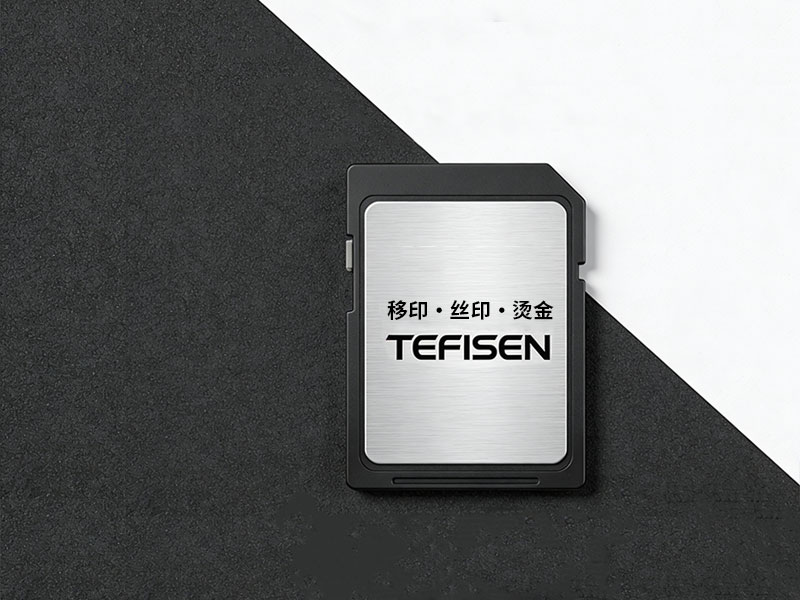
Table 1: Global SD Card Market Key Data
| Metric | 2024 Data | 2030 Forecast | CAGR |
| Global SD Card Market | $2.4B | $2.7B | 2.30% |
| China SD Card Market | RMB 10.512B | RMB 48.86B | 3.00% |
| Global Memory Card Market | $9.7B | $10.8B | 1.90% |
| Micro SD Card Segment | $1.3B | $1.5B | 2.60% |
Sources: Research and Markets, Bezos Consulting
1. Consumer Electronics
People are snapping up smartphones, tablets, drones, and gaming consoles like never before—and they all need more storage. High-end phones these days often come with support for up to 1TB of extra space. That means SD cards have to keep getting faster and packing in more capacity just to keep up.
2. Industrial and Professional Applications
Things like car navigation, dashcams, security cameras, medical devices, and industrial IoT require SD cards that can handle high temperatures and vibration. Plus, they need clear branding and anti-counterfeiting features that come from high-quality printing.
3. Emerging Markets
AR/VR devices and smart cars are opening up new uses for SD cards. Edge computing and IoT are also expanding the playing field.
4. SD Market in China
When it comes to SD cards, China is where the action is. The country cranks out over 60% of the world's supply. And the domestic market alone? It was worth RMB 10.512 billion in 2024—that's more than a quarter of the global total.
Big names like SanDisk, Transcend, ADATA, Panasonic, Kingston, and Longsys are all ramping up production. And when they expand, they need better printing equipment to keep up with demand.
II. Three Core Challenges in SD Card Printing
1. Small Size, High Precision: The Micro-Text Challenge
Think about what needs to go on an SD card—brand logo, capacity like 64GB or 128GB, speed class like Class 10, U3, V30, plus anti-counterfeiting marks. All of that gets squeezed into a tiny space, and some of those details are only 0.2mm big. So the SD Card Pad Printing Machine has to be accurate down to the micron.
Get the precision wrong, and you'll end up with blurry lettering, jagged edges, or colors that are totally off. Next thing you know, whole batches are going straight to the scrap bin.
2. Smooth Surface, Easy to Shift: The Stability Problem
SD cards have a very smooth surface. When the pad hits the card during printing, surface tension and the stickiness of the ink can easily make the card slide around. This not only misaligns the print but also forces constant adjustments and rework, killing both efficiency and yield.
3. Environmental Standards
Europe and North America take in huge volumes of SD cards, but they've got some pretty tight environmental rules. We're talking:
EU REACH – heavy restrictions on chemicals.
RoHS – no nasty substances in electronics.
And extra hoops to jump through for halogens, PAHs, PFOS, and PFOA.
Miss any of those, and your cards won't make it past customs.
III. Tefisen TFS-CP1-200IE: An SD Card-Specific Pad Printing Machine
Why You Need a Dedicated SD Card Pad Printing Machine
General-purpose pad printing machines are designed for regular products. When you throw small size, high precision, and large volume at them, they usually struggle—accuracy isn't high enough, speed isn't fast enough, stability isn't there, and automation is lacking.
The Tefisen TFS-CP1-200IE was built specifically to solve these problems. It's a fully automatic Pad printing machine designed from the ground up for SD card manufacturers, with PLC and touchscreen controls for easy, digital setup.
Table 2: TFS-CP1-200IE Specifications
| Parameter | Value | Notes |
| Printing Precision | ±0.02mm | Handles 0.2mm micro-text easily |
| Printing Speed | 1,200 pcs/hour | Fast enough for high-volume production |
| Steel Plate Size | 100 × 250mm | Standard size, easy to find replacements |
| Ink Cup Diameter | φ90mm | Sealed design—good for the environment and saves ink |
| Max Printing Area | φ75mm | Plenty of room for SD card printing |
| Drive System | Servo drive | High precision, accurate repeat positioning |
| Control System | PLC + Touchscreen | Digital settings, straightforward to operate |
| Auto Cleaning | Standard | Automatically cleans the pad—less downtime |
| Hot Air Drying | Standard | Speeds up ink curing for continuous runs |
What Makes It Work
1. Sealed Ink Cup + Eco-Friendly Ink
That φ90mm sealed ink cup keeps the ink fresh and consistent, wastes less, and is much cleaner to work with. We pair it with our TS‑100 eco‑inks, which already meet REACH, RoHS, halogen, PAHs, and PFOS/PFOA. Basically, your products sail through export inspections without any drama.
2. Smart Control System
Forget complicated dials. The whole system runs on PLC with a touchscreen—you just tap in the settings. It’s all digital, so adjustments are precise and super easy.
3. Auto Cleaning & Hot Air Drying
There’s an auto‑cleaning system that keeps the pad in top shape—no one’s constantly stopping the line to wipe it down. Plus, the built‑in hot air dryer speeds up curing, so the whole line just keeps running without hiccups.
4. Dedicated Pad: TS-F3825
Tefisen also created the TS-F3825 silicon pads (48×35×30mm) just for SD card printing. It's made from imported silicone—anti-static, durable, fine-textured, and springs back nicely. Ink release is smooth, so it pairs perfectly with the TFS-CP1-200IE.
IV. Future Trends in SD Card Printing
1. Smarter Automation: AI + Robots
SD cards are getting faster and holding more data, so our printing has to keep up. We’re moving toward AI-powered vision systems and robots working together. The goal is a fully automated line—we’re looking at a 40% boost in output and much lower labor costs.
2. Eco-Friendly Inks
Going green isn’t optional anymore. We’re switching to UV and low-VOC inks, along with smarter drying systems. That means less energy, fewer emissions, and staying ahead of those strict EU and US environmental rules.
3. More Precision
As storage gets denser, the printing has to get sharper. Next-gen tech will handle micro-text smaller than 0.1mm and even 3D patterns. It’s exactly what high-end brands want for differentiation and added value. A high-performance SD Card Pad Printing Machine will be at the center of this evolution.
FAQ:
1. Q: What’s the best way to print on SD cards?
A: Honestly, pad printing is the way to go. SD cards are tiny and super smooth, and pad printing is the only method that handles that kind of curve and small surface reliably—perfect for logos, capacity labels, and those tiny micro-texts.
2. Q: Can this machine handle micro-text smaller than 0.2mm?
A: No problem at all. The TFS‑CP1‑200IE runs at ±0.02mm accuracy. It can easily do sub‑0.1mm micro-text, and even 3D patterns if you need them.
3. Q: Do your inks meet EU and US environmental standards?
A: Absolutely. We use our own TS‑100 eco‑inks, and they already meet REACH, RoHS, halogen, PAHs, and PFOS/PFOA. So your cards will pass customs and compliance checks without any drama.
4. Q: How fast is the TFS‑CP1‑200IE?
A: It prints around 1,200 to 1,600 times per hour, depending on the layout. That’s over 80,000 cards a day, so it’s built for proper mass production.
5. Q: Can it print on MicroSD cards too?
A: Yes, it’s not just for standard SD cards. We’ve optimized the fixture and the TS‑F3825 pad specifically for small formats like MicroSD and industrial memory cards.
About Tefisen
Tefisen was founded in 2003 and has spent over 20 years building expertise in specialty printing. Today, the company is a leading OEM and ODM provider of high-end printing equipment and related supplies.
Tefisen's product range includes pad printing machines, screen printers, hot stamping machines, plate-making equipment, UV curing units, automation systems, as well as inks, pads, and steel plates. These products serve industries like consumer electronics, cosmetics, home appliances, toys, and automotive. With branch offices in Huizhou, Shenzhen, Hong Kong, Suzhou, Vietnam, and Chongqing, Tefisen provides support to clients around the world.
For more information about SD card pad printing solutions, reach out to sales@tefisen.com.