


News
Pad Printing Pad Factory Selection Guide: What You Need to Know


I've been in the printing industry for over a decade, and I've had my fair share of battles with pad printing pads. These unassuming little silicone rubber pads may not look like much, but if you choose the wrong one, they can cause endless headaches—blurry prints, inconsistent quality, batch-to-batch variation. Any one of these issues can cost you dearly. I learned this the hard way. I once lost over 30,000 yuan on a single batch, and I nearly lost a major client in the process. After that, I got serious about understanding what really goes into these pads. Raw silicone materials, molds, manufacturing processes—every step matters. The final product is only as good as the weakest link. Today, I'm going to share everything I've learned from my mistakes and my years of experience. I'll also tell you about a pad printing pad factory I've worked with—Tefisen—and show you how they do things differently.
I. What Exactly Is a Pad Printing Pad?
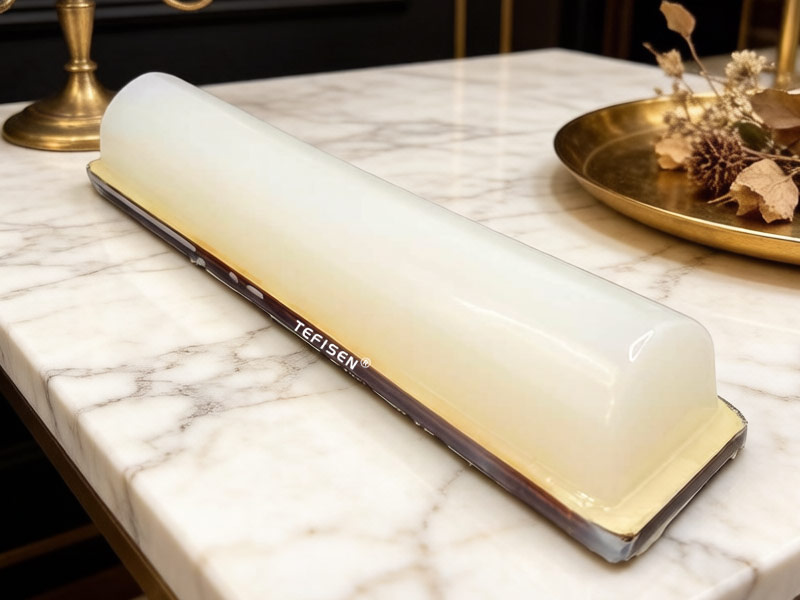
A pad printing pad is essentially a silicone rubber "stamp." The steel plate has an etched pattern; the pad presses down to pick up the ink, then transfers it onto the product. That's the basic idea.
The primary material is liquid pad printing silicone rubber, a two-component addition-cure room-temperature vulcanizing (RTV) silicone. In simple terms, it's a mixture of silicone rubber, silicone oil, crosslinkers, and catalysts, blended together, vacuum-degassed, and then cast into a mold.
|
Parameter |
Value / Range |
What It Means |
|
Hardness |
0A–28A (adjustable) |
Softer for curved surfaces, harder for flat
surfaces with fine details. Tefisen offers 20A–80A (Shore
A), covering most needs. |
|
Shrinkage Rate |
≤0.3% |
Minimal dimensional change after curing, ensuring
high precision. |
|
Tear Strength |
≥3.0 MPa |
Determines durability and resistance to tearing. |
So, if all pads are made from silicone, why do some cost tens or even hundreds of yuan, while others go for just a few bucks?
I once took apart a cheap pad and found it full of air bubbles. A fingernail left a permanent dent. These cheap pads are made from recycled materials and cast in cheap vacuum form molds—poor precision, inconsistent quality, and huge batch-to-batch variation.
This leads to the key question: What should you look for in a pad printing pad factory?
II. Vacuum Form Mold vs. Crystal Mold: More Than Just Mold Cost
Here's something rarely discussed in the industry: pad molds come in two main types—vacuum form molds and crystal molds.
1. Vacuum Form Molds:
• Cheap. A mold costs just a few dozen yuan.
• Poor precision. Rough surface finish.
• Short lifespan. After a few hundred pads, the mold is worn out and needs replacing.
Pads from these molds are what you get for just a few yuan. A pad printing pad factory that uses these is chasing low price over quality.
2. Crystal Molds:
• Expensive. A mold costs several hundred or even thousands of yuan.
• High precision. Smooth surface, consistent pad dimensions.
• Long lifespan. A single crystal mold can produce tens of thousands of pads over years of use.
A pad printing pad factory willing to invest in crystal molds is serious about quality. Tefisen uses crystal molds. And they have their own mold shop—design and machining done in-house, no outsourcing. This brings a real, tangible benefit: it saves time. Outsourcing molds takes at least 7–10 days. Tefisen does it themselves, delivering samples in just 3–4 days. For rush orders, they can get it done in 48 hours.
What does that mean for you? When your production line is waiting, getting pads a few days earlier means less downtime. A day of lost production can cost anywhere from a few thousand to tens of thousands of yuan. So "saving 3 days" isn't just a nice phrase—it's real money.
III. Process Gaps Are Invisible, But Quality Gaps Are Obvious
There are several critical steps in pad manufacturing. Many budget factories skip them to save money, but that's when quality starts to suffer.
1. Vacuum Degassing
Silicone rubber has a high viscosity, and during mixing, air gets trapped. To prevent bubbles from forming in the pad, vacuum degassing is essential. Without it, the pad is full of voids. A bubbly pad will leave pinholes in your prints, causing high scrap rates.
2. Post-Curing
After molding, pads need additional curing in an oven. Basic room-temperature curing takes 4–8 hours at 25°C. But for better performance, post-curing at 150°C for several hours significantly improves resilience and durability, so pads hold their shape longer under repeated use.
3. 100% Inspection
Some factories rely on visual checks by technicians. They don't measure hardness, they don't check dimensions. A reliable pad printing pad factory tests every batch—hardness, dimensions, surface finish—and keeps records for traceability.
Tefisen does all three. Every batch is tested, and records are kept. When you buy from them, you know that the pads you get today will be the same as the ones you got last time.
|
Process |
If Skipped |
What You'll Notice |
|
No vacuum degassing |
Bubbles in pads |
Pinholes in prints, scrapped batches |
|
No post-curing |
Poor resilience |
Prints get blurry as pads deform over time |
|
No 100% inspection |
Batch inconsistency |
Pads vary from batch to batch; machine needs constant re-adjustment |
IV. Solvent Resistance: Why Some Pads "Fear" Inks
Silicone rubber has a solubility parameter of 7.3. Solvents like toluene (8.97), xylene (8.83–9.03), and benzene (9.22) have parameters close to that, so they can swell or degrade silicone over time. On the other hand, solvents like methyl ethyl ketone (9.56), acetone (9.74), and ethanol (12.97) are far enough apart that they cause little to no damage.
In simple terms: most standard inks are fine, but aggressive solvents are a problem.
If you're using UV inks, epoxy inks, or mixed solvents (like 35% benzene + 15% toluene + 10% acetone + 40% MEK), standard pads will wear out quickly. For these applications, you need a solvent-resistant formula. Tefisen offers custom solvent-resistant pads that last 2–3 times longer under aggressive ink conditions.
V. Consistent Quality Is Where the Real Savings Are
Many buyers focus only on the upfront price. If the print looks "good enough," they're satisfied. But they're not accounting for the hidden costs of inconsistent quality.
Consider this example:
A factory buys cheap pads. Halfway through a print run, the pad dimensions shift (because it was cast in a cheap vacuum form mold) and the pattern starts misaligning. By the time they notice, 500 products are scrapped. At 5 yuan each, that's 2,500 yuan down the drain—just like that.
Switching to a reliable pad printing pad factory might cost a few more yuan per pad. But the consistency means no sudden surprises. No scrap from random dimensional shifts. Over a year, the savings from reduced scrap alone can run into tens of thousands of yuan.
This is why you can't just look at the unit price.
VI. Custom Pads Aren't About "Looks" — They're About Reducing Scrap
Some buyers hesitate to invest in custom pads. They think standard shapes are "good enough" and cheaper.
But for certain applications, standard pads really aren't good enough.
Case Study: Optical Components
A client manufacturing optical components had a curved part with deep recesses. Standard round pads couldn't print cleanly on the curved surface. They tried several pad printing pad factories, but none could solve the problem.
Tefisen visited the site, designed a custom conical pad with a profile that exactly matched the part's curvature. After switching, the reject rate dropped from 8% to 2% . That meant over 2,000 fewer scrapped parts per month. At 5 yuan per part, that's 10,000 yuan in monthly savings.
The custom mold cost a few thousand yuan. It paid for itself in less than 10 days. After that, it was pure savings. When you do the math, custom pads often pay for themselves faster than you'd think.
VII. A Factory Worth Mentioning: Tefisen
Tefisen has been around since 2003—over 20 years in the business, focused exclusively on pad printing pads. They're not the biggest; their annual capacity is around 60,000 pads. But they're stable and reliable, well-suited for small to medium batch production.
What sets them apart:
In-house crystal molds. They design and machine their own molds. No outsourcing. Rush samples in 3–4 days, 48 hours for emergencies.
Solid processes. Vacuum degassing, post-curing, and 100% inspection are standard. Raw materials are tested upon arrival; finished goods are fully inspected and traceable.
Solvent-resistant formulations. Custom formulas for UV inks, epoxy inks, and aggressive solvents, with 2–3× longer pad life.
Consistency over low price. They don't compete on being the cheapest. They compete on delivering the same pad every time, batch after batch. That means less downtime, less re-tuning, fewer surprises.
I tracked one client's results before and after switching to Tefisen:
|
Metric |
Before |
After (6 Months) |
|
Pads used per month |
45 |
18 |
|
Reject rate |
4.5% |
1.2% |
|
Monthly total cost (incl. scrap) |
~8,000 yuan |
~2,500 yuan |
That's a 68% reduction in total cost. That's what a good pad printing pad factory can do for your bottom line.
VIII. 3 Suggestions for Procurement
If you're unsure about a supplier, visit them. Check their raw material storage, production equipment, inspection tools, quality control systems, and finished goods warehouse.
Suggestion 1: Don't Just Look at Unit Price — Look at Batch Consistency
Cheap pads have low unit prices, but if each batch is different, your operators will spend hours re-tuning the machine every time. Time is money.
Suggestion 2: Don't Just Look at Samples — Look at the Factory's Quality System
Samples can be cherry-picked. But can the factory deliver the same quality consistently across thousands of pads? That depends on whether they have vacuum degassing, post-curing, and 100% inspection.
Suggestion 3: Don't Fear Custom Molds — Calculate the Payback Period
A custom mold costs a few thousand yuan, which might seem expensive. But calculate how much you'll save each month from reduced scrap. If the payback period is a couple of months, it's a smart investment.
IX. Final Thoughts
A pad printing pad seems like a small, simple part. But don't make the mistake of focusing only on the unit price.
Cheap pads can give you batch-to-batch variation, sudden dimensional shifts that scrap entire batches, and no support when something goes wrong. A day of downtime can cost you thousands. Choose a reliable pad printing pad factory. Spend a few more yuan on a good pad. You'll change pads less often, scrap fewer parts, and spend less time re-tuning equipment. Over a year, the savings add up. If you're looking for a pad supplier, ask them one question: How much can you help me save?