


News
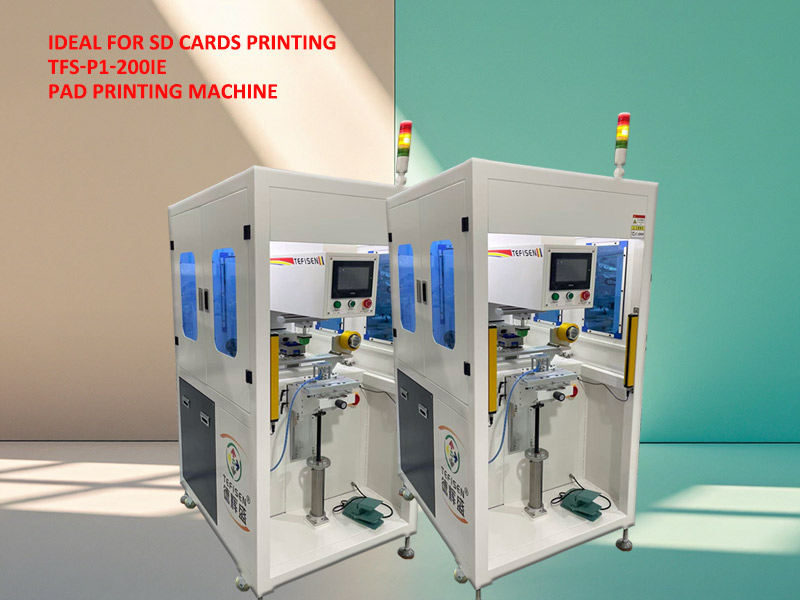
TFS-CP1-200IE Automatic Pad Printer: Revolutionizing SD Card Printing


In the current era where the wave of digitalization surges forward, the demand for digital storage has shown a continuous upward trend. SD cards, with their notable characteristics of compactness, portability, and large-capacity storage, have become indispensable core accessories for numerous electronic devices such as smartphones, digital cameras, and drones. According to authoritative industry data, the market size of China's SD card segment will reach a staggering 10.512 billion yuan in 2025, while the global market size will exceed 41.355 billion yuan, and is expected to continue expanding at an average annual compound growth rate of 33.42%. This explosive growth in the market has placed more stringent requirements on SD card production: it not only needs to meet the demand for large-scale mass production but also has to take into account the refined presentation of product appearance and compliance with environmental regulations. Against this backdrop, the TFS - CP1 - 200IE automatic pad printer from TEFISEN stands out with its high precision, automation, and environmental friendliness, becoming a revolutionary solution in the field of SD card printing.
I. Analysis of the SD Card Printing Market: Demand Upgrade Driven by Technology
1. The growth drivers of the SD card market mainly stem from three core areas:
• The demand for storage capacity in devices such as smartphones and tablets is constantly upgrading, propelling SD cards to accelerate their development towards high-speed and large-capacity directions. For example, high-end smartphones now generally support 1TB of storage expansion, which places higher requirements on the read-write speed and stability of SD cards.
• Scenarios such as drones, dash cams, and security cameras require SD cards to possess special characteristics such as high-temperature resistance and shock resistance. At the same time, brand logos and anti-counterfeiting functions also need to be realized through printing processes to meet the usage requirements of different industries.
• The strong rise of cutting-edge technology fields such as AR/VR devices and smart cars is like injecting a continuous stream of powerful momentum into the application landscape of SD cards, pushing their application boundaries to continuously expand into unknown areas and opening up even broader market spaces.
• Competitive Landscape and Technological Barriers
2. The global SD card market exhibits the distinct characteristics of "head concentration and technological differentiation":
Brands such as Samsung, SanDisk, and Kingston, relying on their profound technological accumulation and well-established supply chain systems, firmly occupy the mid-to-high-end market and have built solid competitive barriers through technological patents.
The high-end market focuses on key technological indicators such as high-speed transmission (e.g., UHS - II standard), large capacity (1TB +), and durability; the mid-to-low-end market takes cost-effectiveness as its core, but also needs to seek a balance between cost control and product quality.
Regulations such as the EU's RoHS and REACH impose strict restrictions on the VOC emissions and heavy metal content of the shell materials of SD cards, prompting printing inks to accelerate their transformation towards environmentally friendly directions such as water-based and UV-curing inks.
SD card printing is not just a simple presentation of brand logos but also a key link in product anti-counterfeiting and function differentiation. For example: Adding visually identifiable information to SD cards, such as brand logos, anti-counterfeiting logos, and key product performance parameters, facilitates consumers to quickly identify and select products during purchase and effectively avoids buying counterfeit and shoddy products. Adopting a standardized information zoning printing process to present core specifications such as speed grades (Class 10, U3, V30) and storage capacities (128GB, 256GB) in a structured and iconographic manner, enabling the unobstructed transmission of product information and allowing users to efficiently identify product information.
II. Difficulties in SD Card Printing: The Dual Challenges of Small Size and High Precision
• In the pad printing process, the insufficient adsorption stability caused by the excessively high surface smoothness of SD cards has become one of the core challenges affecting printing precision. Its specific manifestation is that when the pad printing rubber head dips in ink and then performs the printing action, due to the influence of surface tension and ink viscosity, the rubber head is extremely likely to drive the product to shift or displace at the moment of contact. This will not only directly lead to the offset of graphic and text positioning, undermining the accuracy of overprinting and positional consistency but also significantly reduce the smoothness of production and the finished product yield rate due to frequent adjustments and rework.
• Difficulty in controlling pattern precision: SD cards often require the printing of some high-precision patterns, such as microtext with a font size as small as 0.2mm and gradient patterns with delicate color transitions. To achieve the perfect presentation of these patterns, printing equipment must possess micron-level precise control capabilities. If the equipment precision is insufficient, problems such as blurred text and color discontinuities are prone to occur, failing to meet the high requirements of SD cards for pattern printing.
• Limited printing breadth: SD cards not only have a small printing content area but also require clear printing at the edges on all four sides of the product while ensuring that ink does not penetrate the sides. This requirement poses extremely high challenges to the fineness and coverage of the printing process, requiring printing technology to precisely control the distribution of ink within a limited space and avoid ink overflow into non-printing areas.
• High requirements for ink environmental friendliness: It needs to meet multiple environmental standards including REACH, RoHS, halogens, PAHs, and PFOS/PFOA.
In response to the above major issues, the TEFISEN technical team, after in-depth discussions, launched the automatic single-color pad printer TFS - CP1 - 200IE, achieving technological breakthroughs and process innovations.
III. TFS - CP1 - 200IE: Technological Breakthroughs and Process Innovations
The TFS - CP1 - 200IE is a single-color shuttle pad printer carefully developed by TEFISEN for small-sized products. Its core parameters are as follows:
• Printing size: It supports workpieces as small as 10mm×10mm, perfectly adapting to the printing needs of SD cards and being able to meet the printing production of SD cards of different specifications.
• Precision control: It adopts an advanced PLC control system with an error of less than 0.02mm, ensuring the precise restoration of microtext and gradient patterns and providing a solid guarantee for the high-quality printing of SD cards.
• Degree of automation: Currently equipped with a basic automation module, it can achieve a certain degree of automated production, effectively improving production efficiency. In the future, customers plan to introduce an automatic loading and unloading system and an AI vision positioning module to achieve fully unmanned production throughout the entire process, further enhancing single-line production capacity, which is expected to increase by 40%.
• Environmental compatibility: It adopts an oil cup closed ink cartridge, reducing consumption while improving environmental performance.
Key Technological Breakthroughs
• Vacuum adsorption rubber head: Through negative pressure adsorption technology, the rubber head can firmly grasp the SD card, avoiding printing offset or fly-off. The adjustable adsorption force ranges from 5 - 15N, adapting to cards of different thicknesses and ensuring the stability of the printing process.
• Ink scraping system: It uses imported wear-resistant ink scraping blades, with adjustable angles and pressures in real time, ensuring uniform ink filling, effectively solving the problem of uneven depths in light screen areas, and guaranteeing the uniformity and consistency of printed patterns.
• Intelligent cleaning module: It integrates an automatic cleaning function, automatically cleaning the rubber head and steel plate every 500 prints, reducing ink residue, improving printing stability, and lowering printing defects caused by ink residue.
Process Flow Optimization
• Plate-making process: It adopts a self-developed steel plate production process, with depth precision within the customer's requirements, ensuring the integrity of pattern details and providing a high-quality plate-making basis for high-precision printing.
• Ink management: Through a closed ink tank system, it maintains stable ink viscosity, reducing printing defects caused by viscosity changes and ensuring the quality consistency of each batch of printed products.
IV. Case Application: Practical Verification from the Laboratory to the Production Line
Upgrade of Our Customer's SD Card Production Line
After the customer introduced the TEFISEN TFS - CP1 - 200IE, the following breakthroughs were achieved:
• Production capacity improvement: The single-line daily production capacity reached 80,000 pieces, effectively meeting the explosive market demand and winning more market share for the enterprise.
• Quality optimization: The printing defect rate dropped from 3% to 0.5%, and the clarity of microtext reached the leading level in the industry, greatly improving the appearance quality and market competitiveness of the products.
• Cost reduction: Through the ink circulation system and the automatic cleaning module, the ink consumption per piece was reduced by 20%, and the equipment maintenance cost was reduced by 15%, effectively lowering production costs and improving the economic benefits of the enterprise.
Environmental Compliance Verification
The SD cards of this brand are exported to global markets such as the EU and North America, and the inks need to pass multiple environmental standards including REACH, RoHS, halogens, PAHs, and PFOS/PFOA. TEFISEN launched the TS100 series with high environmental friendliness, which perfectly meets the customer's needs. At the same time, the pad printing rubber head adopts the SD card printing-specific TS-F3825 series, which uses imported silicone material and has excellent ink transfer effects, helping the products smoothly enter the high-end market and providing strong support for the enterprise to expand its international market.
V. Future Outlook: The Dual Trends of Automation and Environmental Friendliness
As the SD card market continues to evolve towards high-speed, large-capacity, and high-reliability directions, the printing process also needs to upgrade synchronously:
• Deepening of automation: In the future, customers will introduce AI vision positioning and robot collaboration technologies to achieve fully unmanned production throughout the entire process, further reducing labor costs and improving production efficiency and product quality stability.
• Acceleration of environmental friendliness: Research and develop inks with lower VOC emissions and optimize the drying process to reduce energy consumption and carbon emissions, promoting the SD card printing industry to develop in a greener and more sustainable direction.
• Breakthroughs in high precision: Introduce high-precision printing technologies to support microtext below 0.1mm and 3D stereoscopic patterns, meeting the customized needs of the high-end market and endowing SD card products with higher added value.
The TEFISEN TFS - CP1 - 200IE automatic pad printer breaks through the difficulties in SD card printing through technological innovation, not only providing an efficient and environmentally friendly solution for the industry but also promoting the manufacturing of storage devices towards intelligence and greenness. In the future where the demand for storage continues to explode, this technological innovation will become the core driving force for the industrial upgrading of SD cards, leading the industry to a new height of development.