

News
How to Choose a Reliable Automatic Pad Printing Machine Manufacturer (2026 Guide)


Last month, another procurement manager called me frustrated. His company had just spent nearly 50,000 RMB on an automatic pad printing machine that couldn't hold registration. The manufacturer promised ±0.02mm accuracy, but what showed up printed everything crooked. When he called for help? Radio silence for three days while his production line sat idle.
1. Sound familiar?
After 15 years in this industry, I've seen it all. Equipment that arrives three months late. Machines that need constant babysitting. Suppliers who disappear after cashing the check. The truth is, choosing the wrong automatic pad printing machine manufacturer doesn't just waste money—it kills your production efficiency for years.
Let me share what I've learned the hard way so you don't have to.
2. The Market Reality Nobody Talks About
The global pad printing market is growing steadily—about 4% annually, expected to hit roughly $290 million USD in 2026. That's attracting all kinds of players. Too many, honestly.
Here's what the numbers don't tell you: the top global manufacturers like TAMPOPRINT, ITW, and Inkcups control less than 30% of the market. That means over 70% is scattered among hundreds of smaller manufacturers. Some are solid regional players like Ronglong or Guangdong Tefisen. But plenty are just... not.
I've walked through factories where "precision manufacturing" meant measuring with a tape measure. I've seen machines assembled with mismatched components from who-knows-where. The price looks tempting, but the hidden costs eat you alive. Finding a truly reliable automatic pad printing machine manufacturer takes more than just comparing price tags.
3. What Actually Matters When You're Buying
First, precision isn't a marketing term—it's a number.
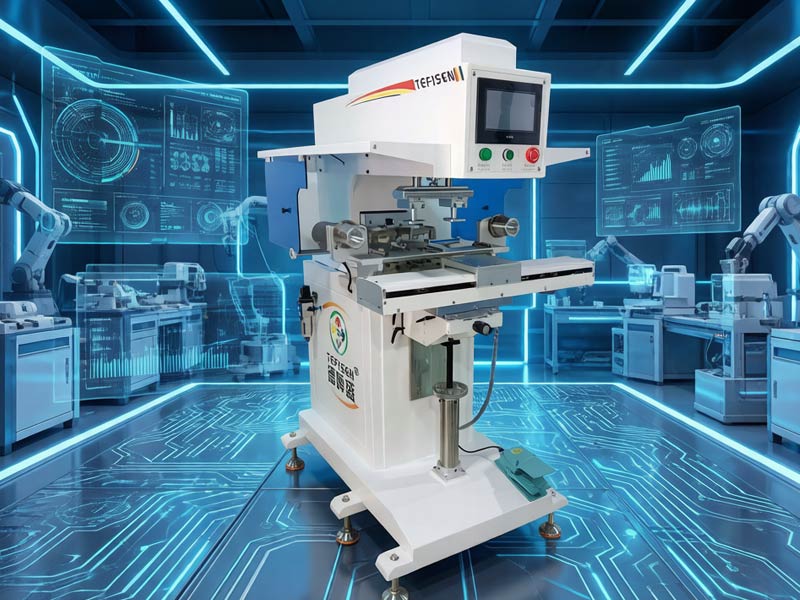
When a manufacturer says "high precision," ask for the actual spec. We're seeing more buyers demand ±0.02mm repeatability, especially in electronics and medical printing. At Tefisen, our TFS-CP2-200IE hits ±0.02mm consistently. The TFS-P4-200S runs ±0.05mm—still good for many applications, but you need to know the difference.
Speed matters too, but don't get hypnotized by max numbers. A machine rated at 1600 cycles/hour means nothing if it can't hold accuracy at that speed. Test it yourself. Run actual parts.
Second, customization isn't optional for most buyers.
I'd estimate 90% of complex parts need some level of non-standard solution. Maybe you're printing on a curved surface. Maybe you need special UV inks. Maybe you need the machine to talk to your MES system.
The best manufacturers build machines that adapt to you, not the other way around. At Tefisen, we treat every order as potentially custom. Sometimes it's just a fixture modification. Sometimes it's a whole new control scheme. But we never assume "standard" will work for everyone. This flexibility is what you should expect from any experienced automatic pad printing machine manufacturer.
Third, what's inside matters more than the nameplate.
Want to know if a machine will last? Look at the components. Festo or SMC pneumatics? That's a good sign. Generic no-name valves? Prepare for maintenance headaches. Siemens or Mitsubishi controls? Solid. A random circuit board from who-knows-where? Pass.
The frame matters too. Cast aluminum construction (what we use) handles vibration better than sheet metal. It's heavier to ship but runs smoother for years.
4. The Service Reality Check
Here's a statistic that actually matters: about 70% of machine issues can be solved remotely within 24 hours with good support. Another 25% need an on-site visit. The remaining 5% are genuine disasters.
The difference between a good manufacturer and a bad one isn't that bad machines never break. It's that good manufacturers answer the phone when they do. Before you commit to any automatic pad printing machine manufacturer, ask these questions:
Who answers when I call after hours?
How fast do you ship spare parts?
Do you offer remote monitoring?
If they hesitate on any of these, keep looking.
5. What You're Actually Paying For
Why does the same model machine cost 10,000 RMB from one place and 58,800 from another?
Here's what the price difference buys you:
What's inside Cheap version Better version
| What's inside | Cheap version | Better version |
| Pneumatics | Generic import | Festo/SMC |
| Controls | Basic microcontroller | Full PLC/touchscreen |
| Ink system | Open reservoir | Sealed cup + auto-clean |
| Support | "Call us" | 24-hour on-site available |
Neither is "wrong." It depends on what you need. But know what you're getting. A reputable automatic pad printing machine manufacturer will be transparent about these trade-offs.
Real Stories from Real Customers
An electronics manufacturer in Shenzhen bought their first Tefisen four-color shuttle last year. Their previous machine ran 8% scrap. After switching, they're under 2%. That's not just better quality—that's hundreds of thousands in annual savings.
A battery company called us at 2 AM once. Their line was down, and they had a morning shipment. Our tech walked them through a fix in 30 minutes. They didn't lose production. They didn't lose the customer. That's what "service" actually means.
6. Where the Industry Is Going
If you're buying in 2026, here's what's coming:
More machines will integrate inline inspection—catching defects as they happen instead of after. Better pad materials that last longer and print finer detail. Digital twins for setup optimization (still early, but coming fast). And definitely more focus on energy efficiency and lower waste.
Good manufacturers are already working on this. At Tefisen, we've opened support locations in Vietnam and Chongqing to get closer to customers. We're testing new eco-friendly ink systems. The industry is changing, and you want a partner who's changing with it. That's the mark of a forward-thinking automatic pad printing machine manufacturer.
7. A Simple Process That Works
After watching buyers for 15 years, here's what works:
Week 1-2: Figure out exactly what you need. Part types. Volumes. Accuracy requirements. Budget. Future plans. Write it down.
Week 2-4: Talk to 3-5 manufacturers. Not just one. Send them your parts. Ask for samples printed on their machines. Compare results side by side.
Week 4-5: Visit if you can. See the factory. Meet the people. Watch machines running real jobs. Trust your gut about who seems capable.
Week 5-6: Negotiate details. Not just price—delivery dates, payment terms, service response times. Get it in writing.
8. Why Tefisen?
Look, I'm biased. I've been with Tefisen for years. But I came here because I believe in how we do things.
We build everything from single-color manuals to eight-color fully automatics. We hit ±0.02mm where it matters. We customize constantly—there's no "standard" customer. We use quality components because we hate fixing things as much as you do. We answer the phone. In short, we strive to be the kind of automatic pad printing machine manufacturer we'd want to buy from ourselves.
Beyond pad printers, we make screen printers, hot stampers, UV curing ovens, and all the consumables—inks, pads, plates, screens. One-stop shopping if you want it. Or just the machine you need.
9. Bottom Line
Buying from an automatic pad printing machine manufacturer isn't buying a machine. It's buying a relationship for the next 3-5 years. The wrong partner costs you in downtime, scrap, and frustration. The right one makes your life easier and your production better.
We've been at this 15 years. We've helped over 2,000 customers across electronics, batteries, automotive, and more. We'd like to help you too.
Got a part you need printed? Send it to us. We'll run samples on our machines and show you what's possible. No pressure. Just proof.